Monday, 14 March 2016

Austin Robinson - World War One aviator - Part 3


Austin returned to RNAS Killingholme for operational training on flying boats in late September 1917. The seaplane base had grown considerably since its establishment in 1914 and this reflected the growing importance of its two major roles - defence against attacks by Zeppelins on East Coast ports and oil installation and defence against submarine attacks on Allied shipping in the North Sea. The threat posed by German submarines was particularly acute.  Earlier in 1917 Germany had resumed unrestricted submarine warfare with considerable success and, by March, twenty-five percent of all British bound shipping was being sunk. By the time Austin arrived back at Killingholme various anti-submarine countermeasures - particularly the introduction of convoys - were helping to reduce losses to U-boats but the allies were still losing over 300,000 tons of shipping per month. Austin was thus entering the conflict at a critical time and the urgent need for flying boat pilots meant that his operational training would be comparatively short. 
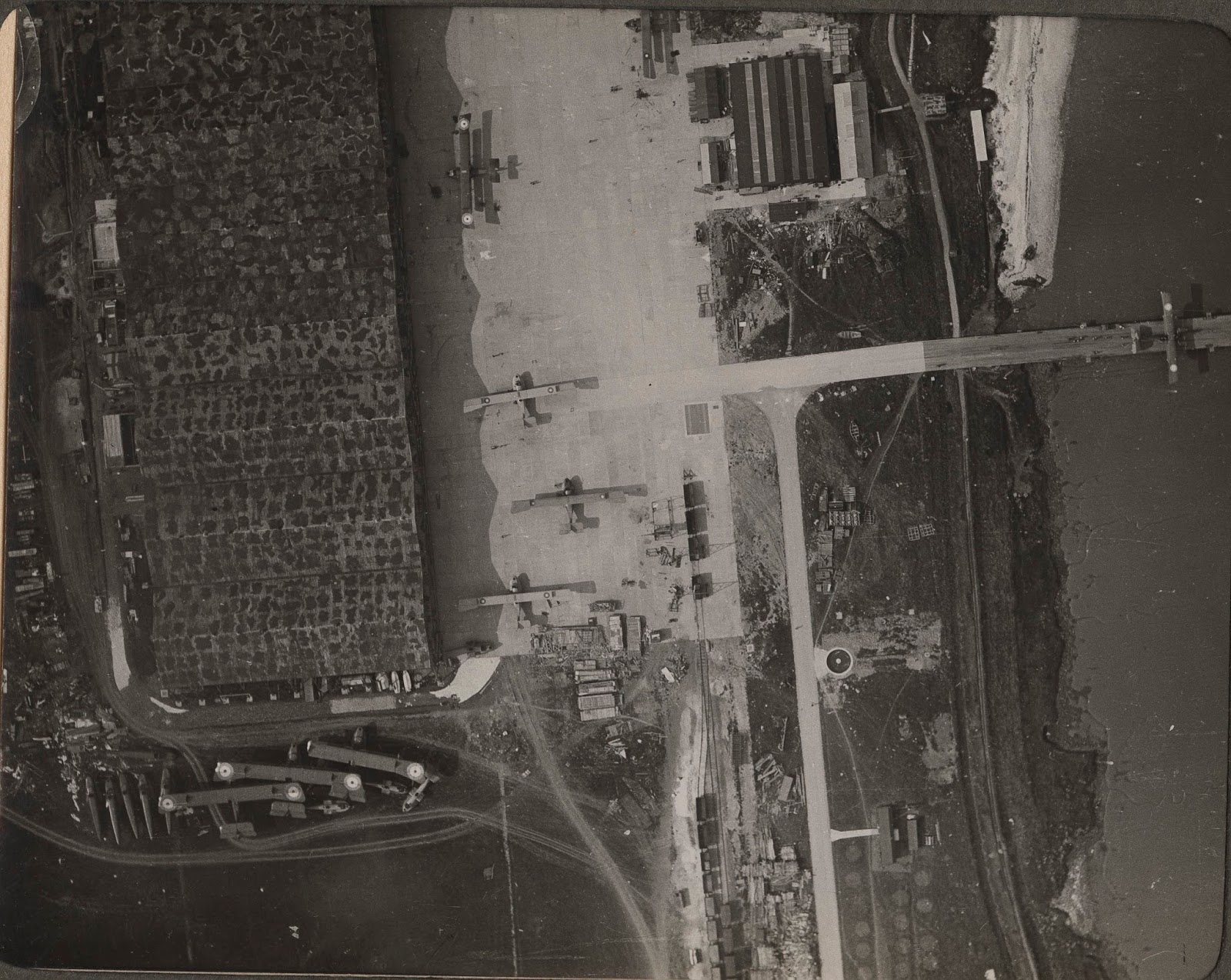
Aerial shot of RNAS Killingholme showing what was then the country's largest hangar (Austin Robinson Papers 12/5/2)
Austin’s operational training lasted barely a month and involved local flights above the Humber estuary in an underpowered Curtis H-4 flying boat. He was not impressed with this aircraft describing it as ‘useless for serious operations’. (EAGR Papers 2/9/4)


The next aircraft flown by Austin was the Curtis H-12 Large America. This was the first really capable flying boat in RNAS service. It carried sufficient fuel for a patrol lasting 6 to 8 hours and a formidable armament of two 230lb bombs and four machine guns.


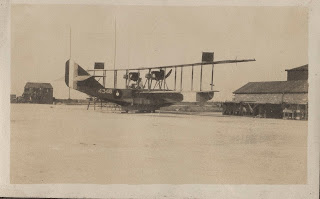
Felixstowe F.2A in US Navy markings pictured at Killingholme (Austin Robinson Papers 12/5/1)


Austin flew his first operational mission on the 16th November when he took a Curtis H-12 flying boat on an anti-submarine patrol from Spurn Head to Flamburgh Head and then 50 miles out to sea and then back to Killingholme.

The purpose of these patrols was to locate and attack German U-boats during the vulnerable stage of their ten hour journey from their Belgian bases to their patrol areas in British coastal waters. Once U-boats were submerged they were virtually undetectable but during their voyage across the North Sea they tried to remain surfaced in order to conserve the power in their batteries. In the absence of radar it was still very difficult to locate U-boats and this is reflected by the fact that aircraft only accounted for 5 of the 140 German U-boats sunk during World War One. This is certainly confirmed by Austin's own operational experience. In the months that followed his initial operation he flew many more anti-submarine patrols but wrote later that "I never saw a German submarine on the surface, nor did I see an indubitable sign of one below the surface. But on various occasions I was called up by someone else who had seen signs of a submarine and dropped my bombs where there was some indication that there was a possible submarine". (EAGR Papers 2/9/4)

Factors other than aircraft - such as the convoy system, mines and hydrophones - certainly played a greater role in the defeat of the U-boat threat during World War One but the role of aircraft should not be underestimated. Austin's account shows that, although the location and destruction of U-boats was extremely difficult, it does seem likely that the presence of RNAS flying boats handicapped their operation by forcing them to submerge early and thus dramatically reduce their speed and efficiency.

 Convoy photographed by Austin while on anti-submarine patrol (Austin Robinson Papers 12/5/3)

Another photo taken by Austin while on patrol, this time of a sinking merchantman. It may have been torpedoed but is more likely to have struck a mine. (Austin Robinson Papers 12/5/3) 

 In addition Austin was also engaged in anti-Zeppelin patrols. In the absence of radar these were also extremely hard to locate and, once located, were often able to escape their attackers by rapidly ascending to higher altitude. This is what happened when Austin sighted a Zeppelin while on patrol in early 1918 while flying a Curtis H-12. Despite climbing to about 8,000 feet and firing "... off a good many rounds of explosive ammunition in the direction of the Zeppelin" it climbed much higher than Austin's aircraft was capable of reaching. (EAGR Papers 2/9/4) The improving efficiency of British air defences throughout 1916 and 1917 had forced the Germans to introduce new Zeppelins - 'height climbers' - capable of attaining altitudes in excess of 20,000 feet. Although this rendered them fairly safe from aerial attack it also imposed severe strain on their crews who were subjected to extreme cold and anoxia, and this made accurate navigation and bombing extremely difficult. Thus, although the flying boats of the RNAS rarely managed to destroy a Zeppelin they did succeed, as Austin's encounter demonstrates, in forcing them to operate at altitudes where thier effectiveness was substantially reduced.

Although the risks from enemy action were comparatively slight there can be no doubt that the long oversea patrols - some lasting up to eight hours - were estremely hazardous and imposed great strain on the pilots undertaking them. Aviation technology was still in its infancy and Austin notes that the flying boat engines were "... not completely reliable. There were various things that could perfectly easily go wrong". (EAGR Papers 2/9/4) Two particular problems noted by Austin were faulty engine magnitos and the fact that the aircraft themselves were not completely rigid and that this often caused fractures in the petrol pipes between the petrol tank and the engine. Either problem could cause an engine to fail which could result in the loss of an aircraft and its crew - Austin notes the "With one engine we could fly for five or ten miles losing height. We could not fly the whole way home". Faced with such a predicament pilots would be forced to land on the sea - if it was sufficiently calm - and try to make repairs.

"Some of us loved the sea" noted Austin, "some of us hated the sea and found it a great strain flying out of sight of land for eight hours or whatever it took to do one of the long patrols". (EAGR Papers 2/9/4) As a result several pilots apparently suffered nervous breakdowns under the contstant pressure of operational flying.
 

 Although Austin never saw a German submarine he took several photos of surfaced British craft. This is an extremely rare photo of  HMS C19 which was then part of the 3rd Flotilla with HMS Hebe at Immingham.  (Austin Robinson Papers 12/5/2)
  
Austin's operational combat flights came to an end in July 1918 when RNAS Killingholme was handed over to the command of the United States Navy. American naval aviators now took on the task of maritime patrols over the North Sea using Curtis H-16 seaplanes.

For the rest of the war Austin's duties involved testing and delivery of newly built flying boats and it is this stage of his career that will be examined in the next blog in this series. 

Thursday, 11 February 2016

Greetings from the new Marshall Librarian


Hello – my name is Clare Trowell and I took over the role of Marshall Librarian on 1 February 2016. My previous post was at the University of Sheffield where I was a Faculty Librarian and the Copyright Officer. I am looking forward to meeting the staff and students of the Faculty of Economics here at Cambridge as well as library colleagues in the affiliate libraries and the University Library. My particular areas of interest in Librarianship include information literacy (user education), scholarly communications, special collections and archives, as well as copyright.
I am new to Cambridge University as well as the Marshall Library so at the moment I am very much enjoying the challenge of trying to understand how the organisation fits together. I feel I have a lot to learn but things are beginning to make sense. I especially enjoyed going to The Old Schools on my first day to sign in The Book. It feels as though I have been inducted and admitted officially to the University.

I am looking forward to working with the library team at the Marshall Library and hope we can build and improve on the excellent library service they already provide. If there are any comments or suggestions that you have for me in my new role then please do not hesitate to get in touch with me.  I will be very grateful  for any feedback.

Wednesday, 30 September 2015

My favourite things

Marshall Library crew a AM's grave, 2015
Fear not, this is not a Sound of Music-inspired farewell song or poem. However, as I’m trying to tie up loose ends, and tidy up my to-do list, inbox and desk, I’m just looking back a bit – before the end of my last full day at work at the Marshall (30 September 2015), after 1 year, 9 months, and 28 days (or 667 days and 8 hours if you prefer; I used a nifty online tool to “calculate” this!).

One of my favourite things – also pretty unusual – was the annual visit and tending to Alfred Marshall’s grave; my colleague, Simon Frost, informed me that this had already been a tradition: the Marshall Library staff going once a year to pay homage to the very gentleman without whom the library would not be what it is today. A minor detail was that the tradition had lapsed for about 21 (or more) years prior to the summer of 2014, but for Cambridge that’s a minor hiccup in a tradition usually measured in centuries. I have to admit though that a) it helps if you are a keen gardener, or b) like to have an outdoor picnic (which happens afterwards). This year’s event was made all the more memorable by being thoroughly drenched on the way back to the office/work, and that I will never forget this thought-provoking shower!

Page of Sponsorship Document
Another activity I had never done before but which turned out to be fun, was to develop – with strong input from Simon and the team – a document of sponsorship opportunities at the Marshall Library (our approach and final version also benefited hugely from the input of Laura Greenfield, a colleague at the UL). Even though none of the potential sponsors we approached at the annual Economics Careers Fair [link only works with a Raven user name and password, i.e. for current members of the University] were that keen, and none ended in sponsorship, it was useful to think of potential ideas for improving our provisions and services, if only we had external funding. It was fun to consider what potential partnerships the Library could engage with, with organisations and companies.

Finally, my initial idea of some guerrilla marketing, to create a stronger awareness amongst students and lecturers that the Marshall Library is very happy to receive recommendations for new books, or more copies of textbooks, resulted in Simon’s suggestion to approach lecturers with the idea of including our PR slide and flyers in their lectures. Again, our colleague Lisa provided the memorable visualisation here of our “cry for ‘HELP!’”.
There are a couple more things I could bore you with, such as the Focus Group we convened, and that thanks to this group of students our Social area now has breakfast bar-type tables and chairs (which are very popular in term time); but in the end, I promised myself to keep this short.
If you are interested in following up on the Sound of Music reference after all, here is a link to the video https://www.youtube.com/watch?v=0IagRZBvLtw


CG 
(Marshall Librarian 2 December 2013 to 30 September 2015)

Thursday, 24 September 2015

Library Survey 2015 – some thoughts

This is the second year we have asked our users for feedback on the Marshall Library via a Survey. This year saw a great increase in Part I students replying (up 10%!), but this goes with a decrease in participations from all other students. Whereas the small increase in number of respondents by 1%, to 24%, is positive, and maybe above response rates for similar surveys, it means that we are not being given a full mandate to follow some of the quantitative questions. However, the following will aim to present some of the noteworthy trends. For a fuller picture, please look at our Marshall Library 2015 Survey Highlights at Piktochart.

63% of all undergraduate students who responded claim to visit the Library twice or more per week (up by 5%). This is interesting, as the overall book borrowing (as for most libraries) has decreased, yet the number of renewals has gone up by 45% for the academic year 2014-15! When we take the students’ word for this activity, the overall trend of lower book borrowing is continuing:
Book borrowing at Marshall Library
Our total number of visitors (gate figures are up by +15%, compared to 2013-14) also backs up the students’ statement that they continue to use the Library as a place of study, and that this function of the library remains to be very important. Naively, one could assume that each student having a college library, and that the Marshall being in close proximity to the UL and other medium to large libraries, such as the Squire Law Library and Seeley History Library, would mean that students are not too fixated on being in their ‘home’ Library, but it seems that a lot of Economics students prefer studying with their peers. For those who are not sure where “home” is: SpaceFinder might be useful.

There is definitely a fan-base for us as a Library, which is maybe indicated by the more than 70% of respondents who say that they have used the Social Area in the Marshall at least once a month or more often. Our increases in opening hours from 54 to 67 hours per week (during term time, 2014-2015 compared to the previous academic year) got a big stamp of approval: 76% of students (up by 24% from 2014) believe that the opening times are okay (apart from 24/7 libraries, most libraries will probably get complaints about their opening hours). Us buying a significant amount more of textbooks between January 2014 and October 2014 has also led to now 74% of students being ‘very satisfied’ or ‘satisfied’ (up 8% from 2014).

Marshall Library Issue Desk with box for book suggestions
When it comes to the crucial textbooks and how happy students are with these being available to them, again 74% of respondents are happy, but it is noticeable that in 2015 no one stated that they were very dissatisfied – an acknowledgement, perhaps, that we are providing significantly more copies of most textbooks than most college libraries. We are always, however, happy to have further suggestions, either for more copies of textbooks (if such copies are available), or of books which might be useful for someone’s dissertation or research (either email us, leave a suggestion form at the Issue Desk, or fill out our online form at http://www.marshall.econ.cam.ac.uk/contactus/book-purchase-suggestion-form)

There are many more observations which could be made – also relating to ebooks usage – but I cannot end this post without busting a myth about student library use in 2015: nearly 80% of respondents ‘disagree’ or ‘strongly disagree’ with the statement that they ‘do not consult physical books much any more’ – making a bit of breathing space for traditional library provisions and librarians:

From Marshall Library Survey 2015

If you found the above interesting, you might also want to read the 132 individual suggestions given by respondents – and our comments.

CG

Monday, 20 July 2015

Something completely different to what I expected

Honestly, since I started year 10, work experience was one of the things I was dreading. I thought it would be two weeks of just doing nothing. However when I came to the Marshall Library I found myself quite surprised with the considerable amount of work to be done, with the varied tasks and jobs required to keep the library running.


On my first day of working in the Marshall Library I was kindly introduced to the staff team by Sue, whom all of which were welcoming. My first day proved to be the most difficult as I was getting into a new routine, as well as in a new place with people I didn’t really know. But as the days went on, work began to get easier and I feel like I made a closer connection with the staff.

Getting to work took me a while as I had to get the 8:11 train and then walk from the station, which took around 25 minutes. However, I soon realised that the library was reasonably close to the town centre, which gave me the opportunity to see my friends at lunch as I had a whole hour, which I took from 13:00-14:00 every day.

During the week my work varied with the tasks I was doing. Firstly I learnt how to issue and receive books to university students as well as collecting book references and checking where they are kept. On one particular day, I was introduced to Anita’s work and how she does cataloguing, which took me by surprise as to how much thorough work has to be done. I found that the work became easier as I became more confident, and it gave me a better understanding of the library environment as well as a work environment.

Aside from all the work, Sue was kind enough to organise visits to other libraries for me. The Cambridge University Library was astonishing; when I was told there were around 8 million books, I found this hard to believe. Finding one specific book which we needed for the Marshall Library was actually enjoyable, and something completely different to what I expected. Because of my particular interest in physics, specifically Cosmology and Astronomy, Sue organised a visit to the Moore Library and the Library of Astronomy. This was exciting for me as I hope to pursue a career in Applied Mathematics and Theoretical Physics, specialising in Cosmology.

Overall, working in the Marshall Library was, admittedly, quite intimidating at first as my knowledge of the library work environment was limited. However, as the days progressed I began to get more comfortable with working and found it easier to undertake any new challenges I was given. I was particularly enthusiastic when Clemens asked me if I would like to do a project which revolved around Economics, so I thought I would use my knowledge of the German Economy from 1919–1929 and apply it to the subject of Economics to create a display for the library.

Display at Marshall Library: 'German Economy from 1919-1929''
Even without any knowledge of working in a library, I still found my two weeks at the Marshall Library particularly enjoyable, and I now feel like I have a much clearer understanding of what work may entail in the near future.

Jodie (work experience 6 to 17 July 2015)

Monday, 13 July 2015

Austin Robinson - World War One aviator - Part 2


Austin arrived at RNAS Cranwell in mid June 1917 for advanced flight training. This consisted of one week each on the Avro 504, the BE2c and the Bristol Scout. During this time he would also have received instruction in advanced navigation, aerial photography, use and maintenance of machine guns and basic bomb dropping. He successfully passed out as a flight sub-lieutenant on July 11th and was posted to RNAS Killingholme on the Humber for further training on seaplanes.

A photo of a Bristol Scout taken by Austin at Cranwell (Austin Robinson Papers 12/5/4)

Killingholme was both a seaplane school and an operational station and it might have been because of this that few aircraft were available for training purposes and, as a result, Austin's opportunities to fly were very intermittent. Nevertheless he passed out successfully on August 10th and was then sent to RNAS Calshott on Southampton Water to complete his seaplane training.

An aerial photo taken by Austin of the flying boat slipways at Killingholme (Austin Robinson Papers 12/5/5)

Austin was not impressed with Calshott. It was in his words, a 'complete disaster'. Firstly, there were hardly any aircraft available for flight training and, secondly, there was a massive back log of personnel waiting to be passed out and assigned elsewhere. The situation was so grave that when it became known that a high ranking RNAS officer would be inspecting the station Austin and his fellow officers decided to mount '... the nearest thing one could have to a demonstration'. In order to draw attention to the enormous number of unposted officers in training everybody assembled in one massive long queue for lunch at the mess hall. The visiting officer obviously took note and all personnel were posted the very next day. 

Austin, who had developed considerable affection for twin engined seaplanes, was delighted to find himself posted back to Killingholme for operational training.

SHF

Tuesday, 7 July 2015

Accessing micro-data (part I)

data.path / FlickR user r2hox (CC BY 2.0)
Obtaining micro-data can be tricky, take time and might actually be virtually impossible (i.e. sometimes it is just not available in the way one thinks it could be available: e.g. either it’s not online, or it has never been collated or presented in the way needed). Hence, if you are thinking of embarking on a research project where your approach relies exclusively or heavily on having access to such data, please do not commit to undertaking such research unless you already have such data. (That is generally a good approach for any data-led or data-centred research, but with micro-data it is absolutely crucial).

The reason for organisations not just handing over such detailed levels of data lies in the data itself: protecting a discrete group of people who might be identifiable by postcode or other means might translate into them not being disadvantaged or singled out. Most organisations have a two-part approach to granting or denying access to such data:
  1. Can you prove that you are a bona fide researcher? This might seem obvious, and depending on the stage in your academic career this can be tricky. However, it is easy to see this step not only as a stumbling block, but also as quite snobbish, or even an elitist stance on the part of the organisations holding such data. But to look at it from the perspective of the guardians of such data: they want to know whether you can make use of the data (i.e. have you got the experience and skills to analyse, present and discuss this data in a way which will provide new insights for scholarship, or even for policy makers). Depending how big, or detailed the data, the organisation asking for your credentials might demand quite a high level of proof to be certain that you can handle such a project academically and in a scholarly manner.
  2. The second part of an application for micro-data can often provide more technical and legal challenges for giving access to such data. Can the researcher guarantee that the data will not be used by anyone else (unless they individually have applied for access too)? Often data may not be stored in open networks, sometimes not even on any local servers or computers; apart from the minimum time required to consult and analyse the raw data itself, the data usually needs to be destroyed once the project is finished. Again, taking the perspective of those who are responsible for keeping such data safe from abuse, one can understand their position.

So, when you have found a micro-data source,

do
  • have enough time to investigate how to apply for access.
  • work on the assumption that you need to apply for access and that this might relate to the two aspects as outlined above.
  • appreciate the position of those responsible for guarding this data
  • accept that such data is usually only disclosed to an individual, not a library, a faculty or a team of researchers.
and do not:
  • waste time in trying to find alternative sources of data, or relying on someone who has access to the data to let you (“quietly”) have access to it too – if this micro-data is worth consulting, then it probably is only available from one source.
  • take the procedure personally; as some of the data relates to real people and their lives, it is deemed worth protecting.
  • plan to have access to such data without having applied for it (just assuming that you will get it quickly is not realistic).

screenshot of  http://bit.ly/1JLbHUh
Just to give one recent example where I was asked for my opinion: the ONS’ Wealth and Assets Survey  is the kind of data where one must apply for Approved Researcher accreditation.
Admittedly, this all is tricky and definitely time-consuming, but the earlier in the process of your research you appreciate the above, the better it will be for deciding whether you can manage to conduct the research you are hoping to do. There are one or two notable exceptions to the above, of which in another post.

CG