Friday, 13 June 2014

Work experience in June 2014

Although my work experience at the Marshall Library of Economics was not what I had planned, as my previous placement on a children’s petting farm came to nothing, I can honestly say that I have enjoyed my first week in the library- and can say books are a lot different to animals!

Work experience student, June 2014
When I first found out that work experience would be taking place in my school I immediately knew that I wanted to find a placement that involved working with animals, and therefore a library, especially one of Economics (which I had zero knowledge about), would not be on the top of my list. However when I arrived at Marshall Library I was made to feel very welcome and have already completed a variety of tasks in a short time, such as shelving books, issuing books, tidying shelves, processing new stock, and completing projects set such as a Datastream and Bloomberg analysis, as well as a social media project- this was all in my first week! The social media project involved preparing ‘tweets’ and Facebook posts that would alert library users to recent and upcoming news, on the Marshall Library’s Twitter page and the Facebook page. For me, I actually prefer jobs which some may say are boring, such as shelving books or tidying the shelves.

Each day I wake up at around 6:30 to catch a 7:20 bus, which takes an hour or so to get to Cambridge depending on the hold-ups - often I find myself drifting off on the bus only to awake and see that we’ve arrived at Drummer Street. In the morning, I arrive at work at for 9am and complete tasks with other members of the staff, who help me out a lot! Then, I normally have a break between 11 and 12 which gives me an opportunity to speak to the other members of staff in the Faculty of Economics, who are all lovely and ask me how my morning has been and proceed to ask me about how my weekend was, or what stuff was going on at school. After having 20 minutes or so of leisure, I continue with the work I was doing, and then have a lunch break for an hour at 12:30. In the afternoon, I participate in projects, which I find satisfying as at the end of the day you can see what work you have achieved. At 4:00, I leave the library and catch a bus back home.

Being a bookworm myself, working in the library has actually been enjoyable, even though I knew nothing about the subject of Economics. Through my first week of work experience, I’ve already gained knowledge through reading the blurbs of texts books or through listening to other faculty members talk about economics in the common room. One advantage of working at the Marshall Library is that it is not far away from the centre of Cambridge, and is also in the grounds of the Sidgwick site, which is near to many other sites which include departments that I find interesting, such as Science and English.

Work experience has benefited me and taught me a lot about the workplace: I have had to manage my own finances, and find a way to get to work on time. My work experience has definitely given me an insight in to what it’s like to have a job, and has definitely helped to influence me on what career path I want to choose when I’m older.


Rowena (work experience student 9 June – 20 June 2014)
 

Friday, 6 June 2014

The J.C. & G.B. Hagelberg collection

Most single book donations either fit into our collections’ profile, or we suggest to the donor that we could pass it on to another library in Cambridge. Less frequently we receive a donation which actually is a collection in itself. The recently catalogued J.C. & G.B. Hagelberg Collection comprises almost exclusively what can be broadly labelled as sugar-related publications, or (more specifically) on sugar production in Cuba.


Jerry Hagelberg; photo: David Ridge
John Paul Rathbone called Jerry Hagelberg (in an obituary at http://blogs.ft.com/beyond-brics/2011/09/09/bye-bye-mr-sugar/) “Mr Sugar”. Hagelberg was born in 1925 in Berlin, Germany, and died in 2011 in Canterbury, England. In the 1960s he worked as a consultant and researcher in Cuba, and advised the government there - and later in other countries - on sugar pro- duction. Hagelberg primarily published as a journalist, not only under his own name, but also under the following pen names: Gerardo Bernardo and Charles Wisley. His private library illustrated that Hagelberg’s thinking and writing was conducted by consulting academic scholarship.

The J.C. & G.B. Hagelberg Collection was much more substantial, but for various reasons we could not take all the books of this private collection. So far we have nearly cat- alogued all the books we have accepted, and you can see the 79 results at http://depfacfm-newton.lib.cam.ac.uk/vwebv/search?searchArg=hkey+Hagelberg&searchCode=CMD*&limitTo=none&recCount=25&searchType=1&page.search.search.button=Search

Whereas some books are more of a historical nature and interest, such as the 1972 publication titled Sugar without slaves: the political economy of British Guiana, 1838-1904 (Marshall Library classmark: 90 I 139), others, such as the 2005 Reinventing the Cuban sugar agroindustry (Marshall Library classmark: 26 FD 21) is a more recent academic collection of writing about sugar production on a large scale.

Some of these books have already been used, others wait for an eager scholar to consult them. We are hoping to include a couple more books from this private collection, in order to make it available to students and academics in Cambridge, as well as any external scholars (but we might need to ask visitors to consult these books outside term time).

CG

Tuesday, 5 April 2011

Walther Rathenau - collection of pamphlets.

We recently discovered a cache of uncatalogued pamphlets by Walter Rathenau in the basement. Walter Rathenau 1867 - 1922 was a German industrialist, politician, writer and statesman who was Foreign Minister of Germany during the Weimar Republic and was assassinated.

Published between 1916 and 1921 and printed in the German Gothic script, the collection of 14 pamphlets seem a significant find and are now catalogued and stored in the Archives Room.

Wednesday, 12 January 2011

The Selected Papers of Partha Dasgupta


Recently published and added to the Marshall Collection. Classmark: 11 D 80

"This two-volume collection represents a body of work spanning 40 years and contains a selection of Dasgupta's most original papers on six key themes. Both volumes feature foundational papers and substantial original introductions. The articles reflect inter-disciplinary scholarship in the author's search for a unifying way to analyse the problems people face in trying to allocate resources over time, among groups, and across uncertain contingencies. Each volume opens with an extended essay explaining the motivation underlying economics; the concept of what economics is about and how modern economists move within it."

Thursday, 7 October 2010

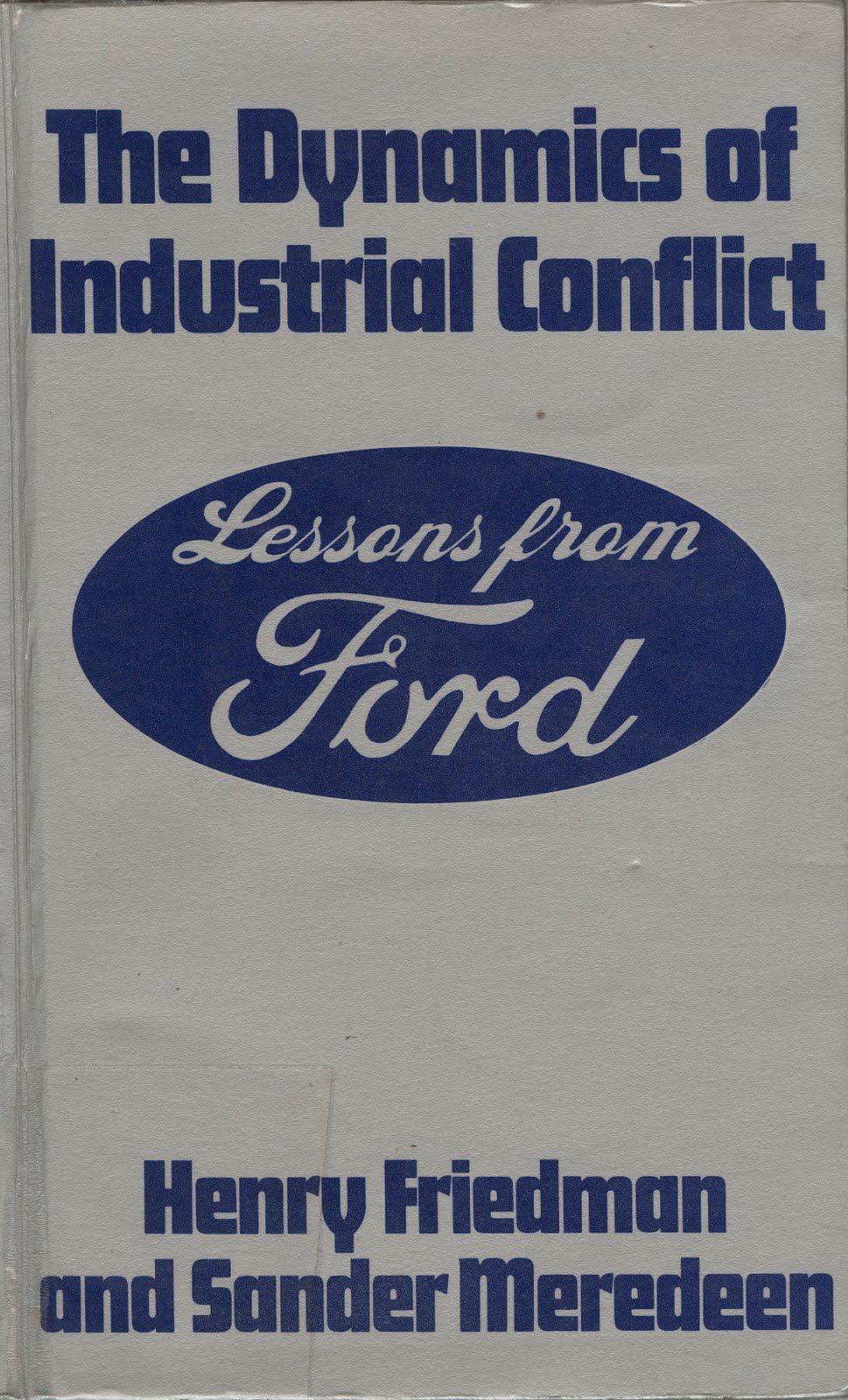
Made in Dagenham


Seen the film ?


Read the book !

Available at the Marshall Library Classmark 67 A 116

Friedman, Henry and Meredeen, Sander
The dynamics of industrial conflict: lessons from Ford.
London : Croom Helm, 1980
Ford Motor company Strike, Dagenham, 1968.
Industrial relations -- England
Strikes and lockouts -- Automobile industry -- England


See also Guardian letters, Wed 6th Oct 2010

Wednesday, 29 September 2010

In praise of Ha-Joon Chang

The Guardian carried an article in its leader column today entitled
"In praise of Ha-Joon Chang" and recommending his latest book "23 Things they don't tell you about capitalism. The article ended .."Ed Miliband: you need to take this man to lunch."

Dr Chang is a regular contributor to the Guardian and his discussions are also available as podcasts from the Guardian website.