Showing posts with label Students. Show all posts

Wednesday, 17 October 2018

Inside the Marshall Library by Barbara Heindl, Work Experience Student from Berlin State Library


When I first applied for an internship at the UL Cambridge, I didn’t expect to get a glimpse into such a diverse landscape of libraries which is part of a university that is at the least just as diverse! Having studied Literature at the University of Tübingen in southern Germany, having started my PhD in Cultural Studies in Frankfurt/Oder and working now in the Berlin State Library while getting another master’s degree in Library- and Information Sciences from the Humboldt-University in Berlin, I thought I knew what to expect. But Cambridge doesn’t work like most other universities. Here, there’s not only the UL, the faculty and departmental libraries but also quite a few college libraries: That means that the entire system works differently and whilst in Germany more or less every person working in a library is called “librarian”, Cambridge offers that title but to the heads of libraries. 
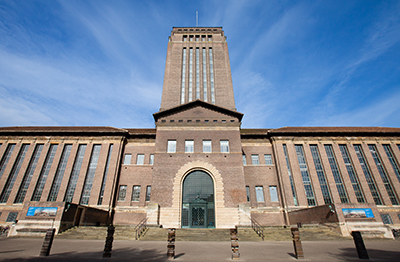
https://upload.wikimedia.org/wikipedia/commons/7/77/Main_UL_building.jpg
cc-by-sa Martin McCormick https://bit.ly/2CQpI5V


However, after two weeks in varied departments of the UL, I got the chance to spend one week in the Marshall Library and that was quite distinct from what I am used to!


© Marshall Library

The day starts off rather calm in the Marshall Library but that changes around 10 a.m. when a wave of students arrives. Most of them try to spend about an hour working in between classes and take the chance to return or borrow books. As library staff, it’s easy to see which books have been recommended in the previous class because the corresponding copies are in a very high demand. 

Both in the Berlin State Library and in the UL library life follows other rules and is a little less dependent on the schedules of students. Most of the readers come in during the morning, find their preferred desks and then stay until the evening, working on a paper or some kind of book etc.
Being above all a place for students also implicates special tasks – some of which might also be a little special to Cambridge. Libraries around Cambridge University try to get hold of as many reading lists as possible in order to provide students with whatever they might need. That means that library staff is checking each and every list to make sure that enough copies are available and that no one has to check different libraries to get that one book you’ll desperately need for your essay. That service is by no means standard in other universities where either students have to figure out how to get their books or teaching staff is scanning page after page – usually poorly paid.
But it’s not all about books, e-books and journals: The Marshall Library also offers training about finding literature and data searching. The Library also provides access to databases and economic data. 


Nor is the Library exclusively about students, the Marshall Library also supports researchers in Economics.  More and more funders expect researchers to publish open access and to provide open data. Researchers might be happy to learn that the Marshall Library knows what makes a good Data Management Plan and how to deposit works in Apollo. What is more: Did you ever think about the impact factor of your paper or the H-index? As that is part of bibliometrics, the library can help understanding these – controversial – measurements and can tell researchers about other possibilities, i.e. about Altmetrics. That might not sound too fascinating and certainly isn’t idealistic research. But it might help to demonstrate the importance and potential impact of one’s work.

As for me, I really enjoyed helping at the lending desk because I usually don’t get to meet the people for whom I’m actually working. In Berlin I’d only spend two hours twice a month at an information desk in the reading room and so it was quite a pleasure to be in touch with the students! 

As the Marshall Lectures take place in November, I was able to get to know somebody else: Robert Shiller. He will lecture on two occasions and the Marshall Library will put on an exhibition about his life, his works as well as books held in the Library. There will even be a video.  http://www.econ.cam.ac.uk/Marshall_Lecture


Tuesday, 26 April 2016

Mary Paley Group Study Room Launch 

by Clare Trowell & Sue Woods

On Friday 22nd April at 2.30pm The Marshall Library launched the new group study room for students. The Reading Room at the Marshall Library is a great silent study space for individual work and the Social Area is welcoming and relaxing but the Library was missing a sensible quiet study area for groups, so this was my first initiative as Librarian to create a useable group study space within the Marshall Library. 

It was a great event - attended by a good number of students and involved bunting and free cake in the Library Social Area, as well as a speech from me!! 

We decided to name the room after Mary Paley, the wife of Alfred Marshall - she was also the first female librarian and an accomplished economist and scholar in her own right. Sue Woods has written a short history of Mary's life:

In 1871 Mary was one of the first 5 women admitted to the University of Cambridge. She spent 3 years at Newnham College studying for the Moral Sciences Tripos. Mary and fellow student Amy Bulley were the first women to be allowed to take the men's tripos. 


Even though Mary passed all her exams, as a woman, she was not permitted to graduate. Mary was, however, invited to become the first woman lecturer in economics at Cambridge and she soon took over the teaching of economics from her former teacher, Alfred Marshall. In 1876 the couple become engaged and they were married the following year. From then on Mary devoted her life to Alfred, and became subservient to him, supporting him in his research and the publication of his work.
Together Mary and Alfred wrote "Economics of Industry", which was published in 1879 under both their names. Even though it was highly rated by Keynes and other leading economists of the day, Alfred disliked the book and allowed it to go out of print, without a murmur from Mary. We were fortunate enough to be able to borrow the first edition of the book from the University Library Rare Books department, complete with annotations by Mary herself.
When Alfred died in 1924 he left many of his books and donated much of his money to the library. Mary acted as a volunteer librarian and looked after the collection for nearly 20 years, until she retired at the age of 87. From 1925 until her death in 1944 she gave £250 annually to the library, and also bequeathed £10,000 to the University for the "development and increased usefulness of the Marshall Library". 

Throughout her life Mary enjoyed painting and produced a bound volume of watercolours, which was passed to the Library for safe keeping. We were also able to display Mary's book of watercolours in the new group study room at the Launch Event.
It was good to get such great feedback from the students about the standard of the new facilities at the launch. The room includes a managed desktop PC, a connection for a laptop as well as a flipchart, pens and magnets for group work.
The room is available to book online via the Marshall Library website (in the same way as Bloomberg & Datastream). The room is available for booking during library opening hours in term time but access to the room closes an hour before library closing time.
The room is bookable for groups of up to 5 for 1-2 hours at any one time and there are some basic ground rules which we ask you to abide by:

  • The Mary Paley Room is bookable by students for group work only and is not available for private study
  • The room may be booked for up to 2 hours (slots) at any one time
  • There will be a 15 minute grace period for each booking. After this time the booking will lapse and the slot may be offered to another group
  • Please make sure you leave the room as you found it
  • No food and drink is allowed in the Mary Paley Room
I really hope students find this new group study space at the Marshall Library useful and I welcome any feedback you may have. 

Clare