Showing posts with label Austin Robinson. Show all posts

Monday, 18 October 2021

Much more than teaching... Marshall Library's extensive and eclectic research collections by Simon Frost, Deputy Librarian


It’s often asserted that the Marshall Library is a teaching library and, during Full Term, this is undoubtedly the case. To suggest, however, that it is solely a teaching library belies the contributions made – and being made – by it’s extensive and eclectic collections of archives and rare books to the work of the numerous researchers who visit the Marshall from all over the World. The majority of these visits occur during vacation and illustrate the way in which the focus of the library changes from teaching to research support with archival enquires, supervision and scanning occupying proportionately more staff time.


The Marshall Library archives consist primarily of the notes, correspondence and photographs of Professor Alfred Marshall (22 boxes) and Professor Austin Robinson (108 boxes). Other Cambridge economists – Pigou, Foxwell and Jevons – are also represented together with extensive lecture notes produced by various undergraduates in the Nineteenth and Twentieth Centuries. There are also some surprises. Mary Marshall, Alfred’s wife and economist in her own right, was also an accomplished water colourist and the collection includes numerous portfolios of her work. Austin Robinson became a pilot during the First World War and flew flying boats with the Royal Naval Air Service and later with Shorts Brothers as a test pilot. He was a keen photographer his archives contain hundreds of unique photographs early aircraft and airships.


Mary Paley's watercolour album                                                

Photos from Austin Robinson's papers


Accompanying these archival materials are many thousands of rare books which originated from the working collections of Marshall, Keynes and other prominent Cambridge economists. Many of these contain significant amounts of marginalia or inter-lea
ved notes. Again, there are surprises.  An inscription in one tome indicates that it was retrieved Herman Goering’s personal train at Berchtesgaden in 1945 and was donated to the library by Nicholas Kaldor who, at the time, was Chief of the Economic Planning Staff of the US Strategic Bombing Survey.

Nicholas Kaldor

For many years these archival collections were poorly organised and widely distributed throughout the Faculty of Economics until, in the late 1990s, the then Marshall Librarian, Rowland Thomas, secured funding from the National Bank of Italy for an archivist to undertake their organization and cataloguing. At the same time the rare books were subject to a programme of retrospective cataloguing in order to make them more accessible and to highlight any notable annotations.

The simple expedient of uploading pdf files of the newly created archival catalogues to the Marshall Library website in the early 2000s garnered considerable interest amongst economic historians worldwide and material in the archives has been used in the production of at least sixteen books ranging from biographies of Marshall, Pigou and Fay to books about flying boats in the Royal Naval Air Service. The most recent publication we’ve provided assistance with is Economics of Visual Art: Market Practice and Market Resistance / Amy Whitaker (2021). We’ve also identified numerous chapters in books and journal articles that have been produced using resources in the Marshall archives.


The Marshall Library has never really been solely a teaching library. The dichotomy between its teaching and research responsibilities has always been there and it’s what continues to make it an interesting place in which to work.

Monday, 28 May 2018

Joan Robinson, a 'pioneering' Keynesian

Joan arrived as an undergraduate at Girton College, Cambridge, in 1922 to read for the Economics Tripos. She had studied history at school, but chose Economics for her degree, as she wanted to understand the causes of poverty and unemployment. She gained a 2:1 but was denied a degree, as this right was not granted to women at Cambridge until 1948. 

In 1926 just two months after her marriage to Austin Robinson, a fellow of Corpus Christi, Joan and Austin sailed to Bombay where Austin took up the post of tutor to the Maharajah of Gwalior.


 Together they led a privileged life, although Joan was not always comfortable at the society events where she was expected to generate small talk. Joan assisted Austin in the drafting  of a review of the relations between the Indian states and the British Crown and was invited to London for the presentation of the Princes' case. Meanwhile Austin resigned from his post as tutor and was reunited with Joan in London where they drafted considerable portions of a book on population. The drafts remained unpublished, as they then moved back to Cambridge where Austin took up a lectureship in 1929.

Joan had to wait until 1934 for her first university post as an assistant lecturer. Although she was not appointed as a teaching fellow, Joan gave supervisions to students from various colleges. At this time she came to know Cambridge economists, including Maynard Keynes, Piero Sraffa, Maurice Dobb,Gerald Shove, James Meade, Dennis Robertson, A.C.Pigou, and of course Richard Kahn, Keyne's favourite pupil and Joan's most trusted critic. Joan had an incisive mind, and she relished the intense discussions held with colleagues in the faculty. Joan joined a small group of scholars referred to as "The Circus", which was formed by Sraffa in 1930 to discuss A Treatise on Money by Keynes. With reference to the group Joan wrote, "Keynes, and all of us, thought that [it] was of great and serious importance to get the argument right; taking credit for it was quite a secondary matter." In 1962, in correspondence with Nicky Kaldor, Joan wrote,  I value very much the work gang and I think that we all do each othjer more good working as a team thatn any one can by having prioriy or "all my own unaided work".

Joan's first publication appeared in 1932 in the form of a pamphlet Economics is a Serious Subject, followed by her first major work The Economics of Imperfect Competition in 1933.
In 1937 she was appointed a lecturer, a reader in 1949 and a professor in 1965, succeeding Austin. Throughout her academic career she worked ferociously, writing books and journal articles, as well as reviews of articles, both favourable and critical. She wrote prolifically about the new ideas being developed by Keynese and contributed much to the debate of employment theory, and the theories of money and international trade. During the Second World War Joan researched Marx's Capital to assess the impact of his economic theory on orthodox economists and Keynesisans.

Much of Joan's writing in the post-war years concerned development issues. She was fascinated by the Chinese experiment, travelling there eight times, as in her opinion China demonstrated how to implement a planned economy, in both urban and rural communities. A theme which recurred in her later years was her vehement opposition to war and the arms industry. Her last public lecture was a criticism of the nuclear arms race: "...never before has so great a proportion of economic energy and scientific study been devoted to means of destruction."

As summarised by Paul Samuelson, Joan sought to find "true socialism", helping to promote justice and equality in many different societies she had encountered throughout her life. She was an original thinker, a passionate seeker after truth, and one of the greatest economists of the twentieth century.

Original research by Sue Woods.

Friday, 27 May 2016

Austin Robinson - World War One aviator - Part 4


 After leaving Killingholme Austin was posted to RNAS South Shields where, between July and October 1918, his duties involved testing flying boats for airworthiness and then delivering them to locations across the UK.

The first flying boat that Austin tested and delivered was N4240, a Felixstowe F3, which he flew south to RNAS Cattewater near Plymouth in Devon. 


 Short 184 flying boats on the Cattewater slipway (Austin Robinson Papers 12/5/5)

His next delivery involved flying  Felixstowe Porte Baby, N9807 north to Houton Bay, which was the RNAS station for Scapa Flow in Orkney. These were extremely long delivery flights - the flight from South Shields to Cattewater could take over 8 hours - and Austin always had to stop to refuel - at Killingholme if going South or at Dundee if going north. 


 Felixstowe Porte Baby No. 9807 after it was wrecked in a gale at Catfirth (Austin Robinson Papers, loose photo in Box 131)
 
Interestingly Austin states that the flying boats that were being assembled at South Shields and that he was testing had, initially, been built at Preston - on the other side of the country in Lancashire! Although appearing at first to be rather improbable this was indeed the case and indicates the way in which aircraft at this time were being built.  Dick, Kerr & Co. - originally a builder of trams and electric trains - had been contracted by the government to build flying boats in their Strand Road works in Preston. They received flying boat hulls from nearby boat builders and then constructed the rest of the aircraft and assembled it. The wings would then be removed and the flying boat transported by road on a steam lorry to South Shields, a journey which took 3 days.

In October 1918 Austin was posted to the naval ferry pool in London and was involved in ferrying flying boats from the locations where they were being constructed - notably Hythe on Southampton Water and Cowes on the Isle of Wight - to Felixstowe and a variety of other RNAS stations. 

After the Armistice  Austin was sent to Rochester where he began testing flying boats built by Shorts and then delivering them to Felixstowe. He remained their until April 1919 and, in his words '... got to know Shorts very well indeed' (EAGR Papers 2/9/4). The Robinson archive contains a large number of photographs that he took while at Shorts - of flying boats being constructed, tested and launched. Many of these pictures provide fascinating insights into the construction of these early aircraft and also clearly indicate the importance of women in industry by this time. A selection of these photographs may be viewed on the Marshall Library web site.

Front of No. 3 erecting shed at Short Brothers, Rochester (Austin Robinson Papers 12/5/6)


Short F3 flying boats under construction (Austin Robinson Papers 12/5/6)

Some of the female workforce at Shorts posing on an F3  (Austin Robinson Papers 12/5/6)

While at Rochester Austin worked closely with Short's chief test pilot John Lankester Parker to determine the airworthiness of the flying boats being produced there. Rejection of a particular aircraft was a serious matter as it would mean that Shorts would not get paid for it and this happened on one occasion when a Felixstowe F3 proved to be 'intolerably tail heavy' (EAGR Papers 2/9/4). The problem was referred to the aeronautical engineers at the Felixstowe Seaplane Experimental Station who suggested raising the entire tailplane by 4 inches and, once this was done, '... the boat was perfectly comfortable to fly' (EAGR Papers 2/9/4). Austin observed that 'It taught both of us a lot that we did not know about some of the more curious aspects of aircraft design' (EAGR Papers 2/9/4).

Austin's last flight as a flying boat pilot occurred in April 1919 when, on the suggestion of Oswald Short, he took his younger brother Christopher on a flight in N4033, a Felixstowe F3. The flight was uneventful and the following day he travelled to Cambridge to begin his studies as an undergraduate at Christ's.


Monday, 14 March 2016

Austin Robinson - World War One aviator - Part 3


Austin returned to RNAS Killingholme for operational training on flying boats in late September 1917. The seaplane base had grown considerably since its establishment in 1914 and this reflected the growing importance of its two major roles - defence against attacks by Zeppelins on East Coast ports and oil installation and defence against submarine attacks on Allied shipping in the North Sea. The threat posed by German submarines was particularly acute.  Earlier in 1917 Germany had resumed unrestricted submarine warfare with considerable success and, by March, twenty-five percent of all British bound shipping was being sunk. By the time Austin arrived back at Killingholme various anti-submarine countermeasures - particularly the introduction of convoys - were helping to reduce losses to U-boats but the allies were still losing over 300,000 tons of shipping per month. Austin was thus entering the conflict at a critical time and the urgent need for flying boat pilots meant that his operational training would be comparatively short. 

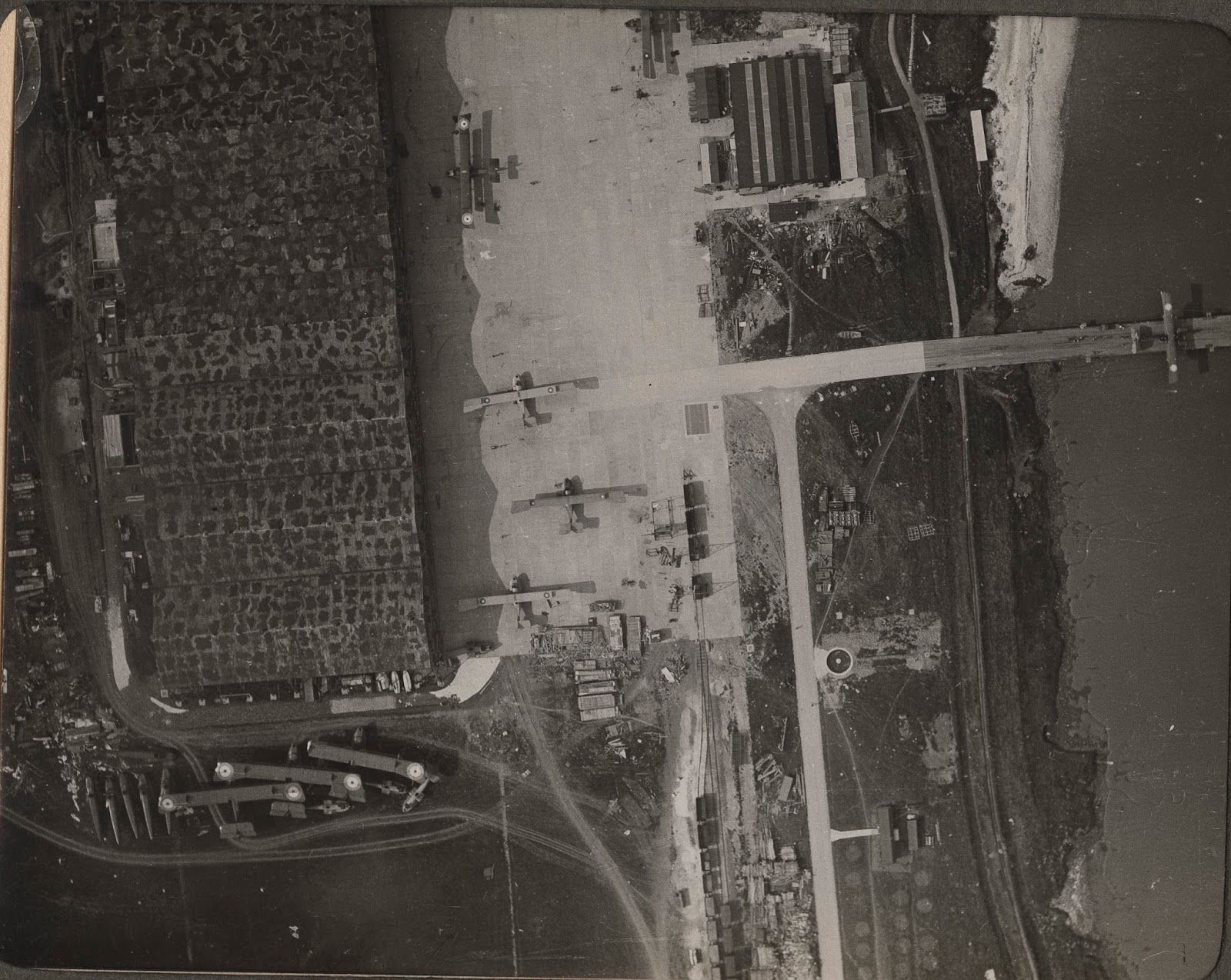
Aerial shot of RNAS Killingholme showing what was then the country's largest hangar (Austin Robinson Papers 12/5/2)

Austin’s operational training lasted barely a month and involved local flights above the Humber estuary in an underpowered Curtis H-4 flying boat. He was not impressed with this aircraft describing it as ‘useless for serious operations’. (EAGR Papers 2/9/4)


The next aircraft flown by Austin was the Curtis H-12 Large America. This was the first really capable flying boat in RNAS service. It carried sufficient fuel for a patrol lasting 6 to 8 hours and a formidable armament of two 230lb bombs and four machine guns.


Felixstowe F.2A in US Navy markings pictured at Killingholme (Austin Robinson Papers 12/5/1)


Austin flew his first operational mission on the 16th November when he took a Curtis H-12 flying boat on an anti-submarine patrol from Spurn Head to Flamburgh Head and then 50 miles out to sea and then back to Killingholme.

The purpose of these patrols was to locate and attack German U-boats during the vulnerable stage of their ten hour journey from their Belgian bases to their patrol areas in British coastal waters. Once U-boats were submerged they were virtually undetectable but during their voyage across the North Sea they tried to remain surfaced in order to conserve the power in their batteries. In the absence of radar it was still very difficult to locate U-boats and this is reflected by the fact that aircraft only accounted for 5 of the 140 German U-boats sunk during World War One. This is certainly confirmed by Austin's own operational experience. In the months that followed his initial operation he flew many more anti-submarine patrols but wrote later that "I never saw a German submarine on the surface, nor did I see an indubitable sign of one below the surface. But on various occasions I was called up by someone else who had seen signs of a submarine and dropped my bombs where there was some indication that there was a possible submarine". (EAGR Papers 2/9/4)

Factors other than aircraft - such as the convoy system, mines and hydrophones - certainly played a greater role in the defeat of the U-boat threat during World War One but the role of aircraft should not be underestimated. Austin's account shows that, although the location and destruction of U-boats was extremely difficult, it does seem likely that the presence of RNAS flying boats handicapped their operation by forcing them to submerge early and thus dramatically reduce their speed and efficiency.

 Convoy photographed by Austin while on anti-submarine patrol (Austin Robinson Papers 12/5/3)

Another photo taken by Austin while on patrol, this time of a sinking merchantman. It may have been torpedoed but is more likely to have struck a mine. (Austin Robinson Papers 12/5/3) 

 In addition Austin was also engaged in anti-Zeppelin patrols. In the absence of radar these were also extremely hard to locate and, once located, were often able to escape their attackers by rapidly ascending to higher altitude. This is what happened when Austin sighted a Zeppelin while on patrol in early 1918 while flying a Curtis H-12. Despite climbing to about 8,000 feet and firing "... off a good many rounds of explosive ammunition in the direction of the Zeppelin" it climbed much higher than Austin's aircraft was capable of reaching. (EAGR Papers 2/9/4) The improving efficiency of British air defences throughout 1916 and 1917 had forced the Germans to introduce new Zeppelins - 'height climbers' - capable of attaining altitudes in excess of 20,000 feet. Although this rendered them fairly safe from aerial attack it also imposed severe strain on their crews who were subjected to extreme cold and anoxia, and this made accurate navigation and bombing extremely difficult. Thus, although the flying boats of the RNAS rarely managed to destroy a Zeppelin they did succeed, as Austin's encounter demonstrates, in forcing them to operate at altitudes where thier effectiveness was substantially reduced.

Although the risks from enemy action were comparatively slight there can be no doubt that the long oversea patrols - some lasting up to eight hours - were estremely hazardous and imposed great strain on the pilots undertaking them. Aviation technology was still in its infancy and Austin notes that the flying boat engines were "... not completely reliable. There were various things that could perfectly easily go wrong". (EAGR Papers 2/9/4) Two particular problems noted by Austin were faulty engine magnitos and the fact that the aircraft themselves were not completely rigid and that this often caused fractures in the petrol pipes between the petrol tank and the engine. Either problem could cause an engine to fail which could result in the loss of an aircraft and its crew - Austin notes the "With one engine we could fly for five or ten miles losing height. We could not fly the whole way home". Faced with such a predicament pilots would be forced to land on the sea - if it was sufficiently calm - and try to make repairs.

"Some of us loved the sea" noted Austin, "some of us hated the sea and found it a great strain flying out of sight of land for eight hours or whatever it took to do one of the long patrols". (EAGR Papers 2/9/4) As a result several pilots apparently suffered nervous breakdowns under the contstant pressure of operational flying.
 

 Although Austin never saw a German submarine he took several photos of surfaced British craft. This is an extremely rare photo of  HMS C19 which was then part of the 3rd Flotilla with HMS Hebe at Immingham.  (Austin Robinson Papers 12/5/2)
  
Austin's operational combat flights came to an end in July 1918 when RNAS Killingholme was handed over to the command of the United States Navy. American naval aviators now took on the task of maritime patrols over the North Sea using Curtis H-16 seaplanes.

For the rest of the war Austin's duties involved testing and delivery of newly built flying boats and it is this stage of his career that will be examined in the next blog in this series.